
AI Fraud Detection: How It Works
More than half of all companies in the financial services industry rely on a fraud detection AI. Read through this comprehensive guide to find out why and how AI fraud detection works.
Table of Contents
[ show ]- Loading table of contents...


AI fraud detection uses machine learning to catch fraudulent documents and applications before they reach a credit decision.
For banks, credit unions, and lenders, that most often means spotting fake bank statements, altered pay stubs, and synthetic identities submitted during underwriting or account opening, which is a different problem than the real-time transaction monitoring most people picture when they hear "AI fraud detection."
More than half of financial services companies now rely on some form of AI for fraud detection. This guide covers how AI fraud detection works at the document layer: what it catches, how the underlying technology works, and how it's different from transaction-monitoring tools built for a different kind of fraud.
For the full picture of how document-originated fraud differs from transaction monitoring, see our guide to AI fraud detection for lenders.
Why use AI for fraud detection?
A customer applies for a loan through your automated underwriting system. You're pinged to review the application: bank statements, tax documents, a driver's license, and a filled-out form. At first glance, everything checks out; the address matches the license, and the income looks healthy.
Except the bank statement and tax documents are forged. And this can happen hundreds of times a day.
Even experienced fraud investigators can't always keep pace with rising application volume, and modern image-editing tools make it nearly impossible to catch a well-made forgery with the naked eye. That's the gap AI fraud detection is built to close: a second, or even third, set of eyes on every document, at the speed applications actually come in.
Manual review vs. rule-based detection vs. AI
Before AI-powered fraud detection, fraud teams relied on manual review: investigators eyeballing documents against specimen files, a slow process that doesn't scale with digital, high-volume application flow.
Rule-based detection was the next step, systems programmed with known fraud patterns that flag matches automatically. It's faster than manual review, but rules only catch what's already been seen. New fraud tactics slip through until a human updates the rule set, which is exactly why fraud teams are moving to machine learning: models that learn what legitimate documents look like and flag what doesn't fit, including patterns no one has explicitly programmed in yet.
How AI agents detect fraud at the document layer
Document-layer AI fraud detection works by analyzing the document itself, not the transaction it's attached to. Inscribe's AI agents examine metadata and pixel-level detail to check a document's integrity, and compare it against known-legitimate documents (for example, real bank statements from a given institution) to catch inconsistencies in fonts, layouts, and formatting that indicate tampering. The system also classifies document types (pay stubs, tax forms, utility bills) and extracts the data needed for underwriting, so fraud detection and data extraction happen in the same step rather than as two disconnected tools.
This is what Inscribe's AI risk agents are built for: reasoning across a document the way a trained fraud analyst would, rather than matching against a fixed rule set. That distinction matters because document fraud is increasingly AI-generated; deepfake bank statements and AI-edited pay stubs look convincing to the eye but leave detectable traces at the metadata and pixel level. Generative AI fraud is the fastest-growing category Inscribe sees in its own detection data, which is exactly why static, rule-based systems are losing ground to models trained to spot AI-generated artifacts specifically.
Agentic AI for fraud detection takes this further, letting AI agents investigate a flagged document and resolve straightforward discrepancies with minimal human intervention.
As Matt Overin, Manager of Fraud Risk Management at Logix Federal Credit Union, put it after adopting Inscribe:
"Today, with the internet and sophisticated tools to create any document you want, we really need something we can trust to look beyond what my investigators can see with the naked eye."
Document-layer detection vs. transaction monitoring
"AI fraud detection" gets used as an umbrella term for two fairly different categories of tool. Here's the distinction:
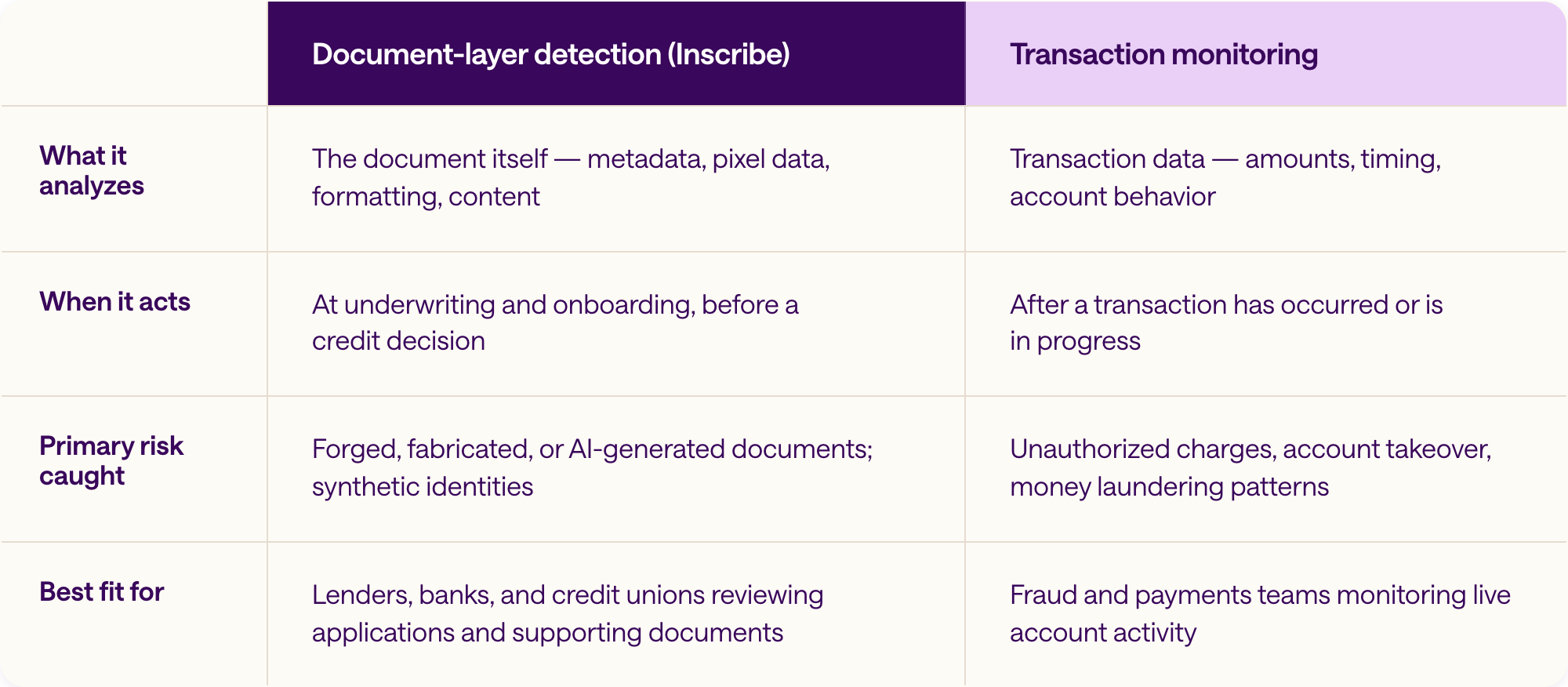
The two aren't competitors so much as different layers of the same fraud-prevention stack. Document-layer tools catch what transaction monitoring is never positioned to see, because by the time a transaction happens, a fraudulent document has often already been approved.
Real results from document-layer AI fraud detection
Logix Federal Credit Union's investigators used to eyeball pay stubs and W-2s against specimen files by hand. After adopting Inscribe:
"We started using Inscribe in late April last year. And in just eight months, we saw potential loan fraud savings of over $3 million and countless ID theft saves." — Matt Overin, Manager, Fraud Risk Management, Logix Federal Credit Union
Kinecta Federal Credit Union saw a similar shift: document review that used to take over an hour now takes seconds, cutting review time by 99% and saving $850,000 in potential fraud losses.
Across Inscribe's own detection data, roughly 1 in 16 documents submitted to financial institutions show signs of fraud, and AI-generated document fraud grew 5x between April and December 2025: a trend that's accelerating the shift from rule-based to AI-driven document review industry-wide.
Protect your organization from fraud with AI
AI fraud detection isn't a fad; for lenders, banks, and credit unions, it's quickly becoming table stakes. If you're reviewing loan applications, onboarding new accounts, or underwriting credit, having a way to catch fraudulent documents before they inform a decision is critical.
Talk to one of our experts to see what Inscribe's AI agents catch in your documents.
About the author
Brianna Valleskey is a B2B marketing leader and Head of Marketing at Inscribe, where she leads the company's full marketing function and go-to-market strategy. She oversees brand, product marketing, demand generation, ABM, content, SEO/AEO, events, partnerships, and marketing operations, with responsibility for marketing pipeline and SQO targets. A former journalist and longtime storyteller, Brianna specializes in translating complex AI, fraud, identity, and fintech topics into clear narratives for enterprise audiences. She is the creator and host of Good Question, Inscribe's podcast on AI and fraud risk, and leads Inscribe's annual State of Document Fraud report.
Learn More
Dive deeper into document fraud

What will our AI Agents find in your documents?
Start your free trial to catch more fraud, faster.